
On Not 'Fighting Gravity'
What Jay-Z's evolution from Reasonable Doubt to 4:44 is teaching me about writing my second novel.

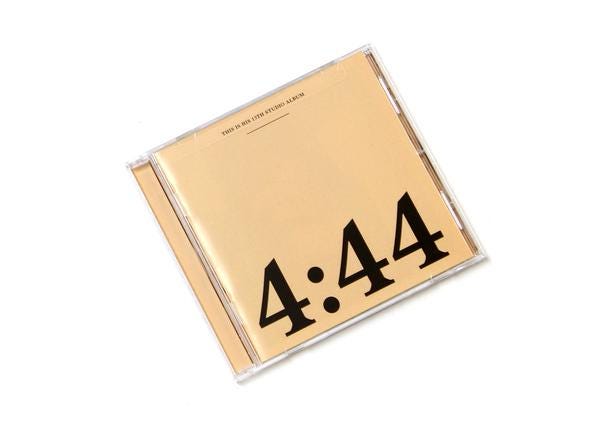
I’ve been thinking about some things Jay-Z has recently said about his evolution as an artist—an evolution I admire just as much as I admire the evolution he’s made as a human being; as a fellow man who came from the dirt and emerged from it all without a stain on his shirt.
In a recent interview with The New York Times, Jay reflects on an artistic journey that produced the boisterous, self-assured Reasonable Doubt in 1996 and 4:44 in 2017: an introspective, probing album—one of the most emotionally mature commercial rap albums ever made. Speaking about how he was able to grow as an artist during his career, he said he’s always striven to embrace who he is during each juncture of life, instead of trying to pretend he’s a younger version.
Artists who try to make work as if they were still a previous version of themselves instead of exploring the more vulnerable and uncertain here and now are “fighting gravity,” Jay says. They’re also attempting to pull the wool over an audience that will notice: “…if you trying to make young music and you not young, it’s going to be inauthentic. And people can feel that.” The best thing artists can do, he says, “is to tell their story and keep creating from that space.”
These are simple words, but they hit me hard because I’ve come to realize that in many ways what is difficult about this second book I’m working on isn’t the subject matter, or the execution of the idea, or the characters so much as becoming comfortable in an entirely new creative register and way of thinking and being.
In many ways I’m no longer the same person as I was when I wrote my first novel. It’s been a solid decade since I lived in New York City, and about a half-decade since I put aside my journalism career and all the bullshit in the media industry to focus on my fiction.
I don’t feel as strongly about the issues that animated my first novel. And because I was writing from that register then—truthfully and honestly exploring what I was experiencing—I got out everything I needed to say about the subject already.
But today, I’m a hardcore suburban dad of two kids, dog.
These days, I care about whether I’m teaching my kids the things I’m supposed to be teaching them as a dad. I care about the fact that figuring out what things are the right things to teach them is just as hard as figuring out how to teach them. I care about trying to find my way—and help my kids find their way—in a culture intent on optimizing everything for the hell of it without stopping to think about where we should draw the line on what’s worth outsourcing to a machine and what isn’t.
The latest media scandal or the latest person getting canceled online (does that shit even still happen?) barely occupies space in my mental. Here’s some of the shit that does: How I’m supposed to teach my son good self-regulation techniques when I’ve barely figured those out myself. How I really need to get around to making a trust so the money I die with doesn’t end up in lawyers’ pockets. How to get my daughter potty-trained by the summer. All the fixes I need to make in my house and how the hell I’m going to pay for them. Even my bird feeder, and the squirrels who keep eating the fucking food out of my bird feeder (yes, that’s how we moving these days).
Needless to say, creating characters who inhabit this register of life feels far less familiar to me artistically. It demands more of everything: time, care, skill, attention. And because I’ve never really created from this new space before, everything carries with it the uncertainty of whether or not it will work; whether or not it will be any good or interesting.
It would be easier to write a Victim Part 2, for example. (Still A Victim is my working title.)
Shit, I had an idea for it the other day. Instead of someone lying about their trauma and pimping their identity to get ahead as a writer, they LLM their way to the top before getting exposed. (Someone should run with that.)
But I’ll never do it. It would feel too derivative and wouldn’t be as interesting to me. It would compromise the discovery, distillation, and sense-making of life as you’re living it that is needed to make good work. It would compromise the process needed to grow as an artist and human, so that you can give an audience something that speaks to their own growth.
Listen to Reasonable Doubt and 4:44 back to back to see what I’m talking about.
What you’ll find is the same rapper in each project, with the same basic set of skills. But what is different is that those skills are aimed at his life as it was in the moment, and all the moments leading up to it; they are aimed at his immediate concerns and beliefs and private struggles.
In the case of Reasonable Doubt, Jay-Z is both predicting his own rise and the industry he’ll be fighting against, with a poise, confidence, and wordplay that not only hints at his talent, but at his vision of the future he’s set on attaining.
On 4:44 meanwhile, he deploys all of those skills—heightened now with time and practice and mastery—at the difficulties he’s having managing marriage, fatherhood, his parents passing and aging, the baggage his upbringing has left him holding, and the sense from many that he doesn’t do enough for his community.
Songs like “Legacy” won’t get played on the radio or in the club, but lines like “Generational wealth that’s the key / my parents ain’t have shit so that shift started with me” still make me all tingly—even a decade later.
When you listen to those two albums back to back, you will notice that in many ways, Jay-Z’s voice is still the same. Even today, 30 years into his run, you can trace it back to his roots. But on records like 4:44 you can also see how it’s an evolved version; a voice concerned with new things, trained on new targets. He’s no longer a 26-year-old bragging about street wealth. He’s a 47-year-old man rapping, skillfully, about 47-year-old problems. “That’s a real chapter in life that got recorded,” he told GQ recently, speaking about the album. We as fans get to watch that evolution, that chapter, and take part in it, and see our own trajectories in a new light as a result.
But dammit, it ain’t easy to do that shit.
It’s harder, and murkier, and more confusing in many ways. And I guess hearing Jay-Z’s words in these interviews reminded me that it’s supposed to feel that way.
It’s supposed to feel different when you’re trying to make something from a version of yourself you’re still figuring out. That’s the whole point. It’s a feature of this shit, not a bug.
Peace,
Andrew
I still can't self-regulate and I'm now in the dreaded 45-54 age bracket. Also, don't fight the squirrels; you'll lose.
I’m challenged by this. Always thought everything he put out was downhill from reasonable doubt. Will have to revisit 4:44